A space open to everyone: the adaptation of the Chernobyl Museum
To mark the 40th anniversary of the Chernobyl nuclear disaster, the Chernobyl Museum in Kyiv has modernized its facilities and made them more accessible to all visitors—regardless of their physical abilities. The museum team approached RCBU with a task that aligns with one of its key priorities: creating elements that ensure comfortable spatial orientation for people with visual impairments.
The key objective was to ensure a comfortable experience for blind and visually impaired visitors. The design department developed a tactile museum map—a relief map of the space that allows visitors to independently navigate the building: to understand the location of the entrance, exhibition halls, and auxiliary rooms. The map is installed so that it is the first informational element a visitor encounters—even before the tour begins.
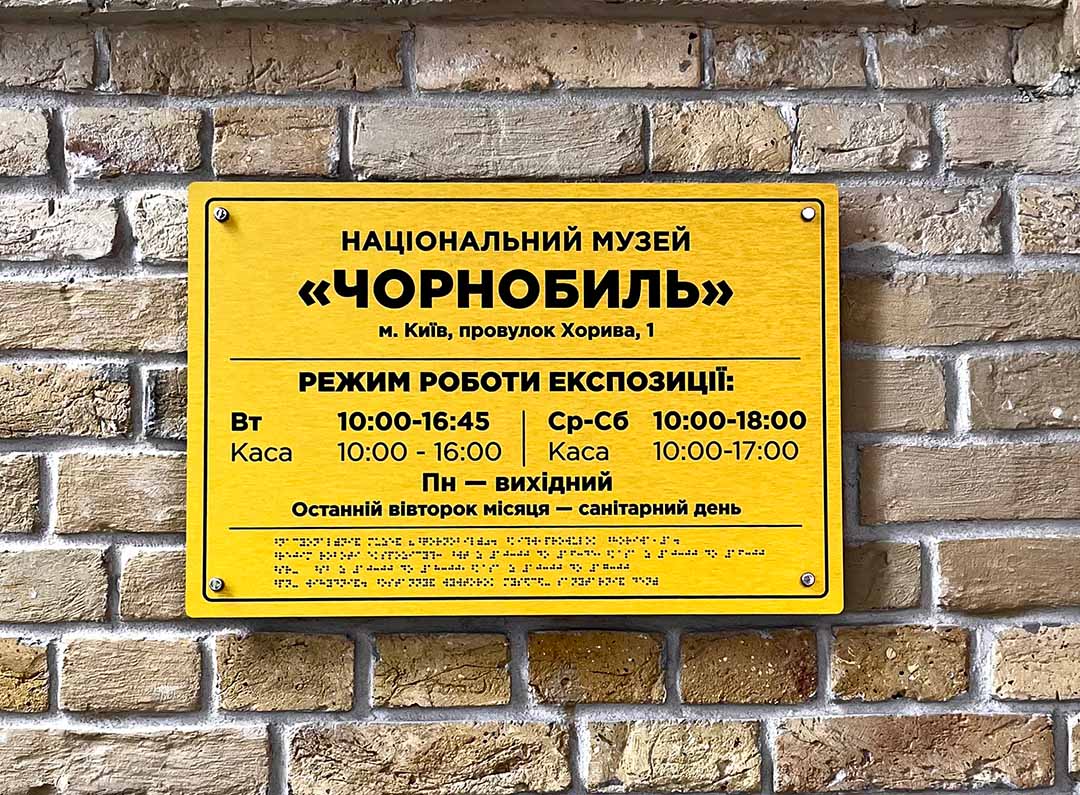
A separate facade sign for the museum was designed and installed. It serves both an orientational and a representative function.
To facilitate navigation inside the building, tactile signs for the rooms have been produced. Each sign contains information in Braille and raised text, allowing visually impaired visitors to independently identify the halls, service areas, and auxiliary rooms without assistance.
As part of the project, a number of practical safety and accessibility issues were addressed: warning signs were installed in high-risk areas, transparent glass doors were marked with special stickers for better visibility, stairs were fitted with anti-slip aluminum treads, and informational stickers were applied to handrails to aid navigation.


A separate element of the project is a tactile representation of “Polishchuk”—a relief copy that allows blind visitors to interact with the artwork through touch. More such works are planned for the museum; this element is the first step toward creating a comprehensive tactile collection.

The implementation of such projects aligns with the principle that guides the company’s work: an accessible environment is not a technical requirement, but a condition for equal access to culture and memory. A space that preserves a shared tragedy must be equally accessible to all.