An Ordinary Morning in an Unfamiliar Place
Imagine an ordinary morning. A new city, an unfamiliar street—or just a building you’ve never been to before. Maybe you’ve moved. Maybe you’ve been sent to a new clinic. Maybe you’ve just come to a government office for the first time.
You get off the bus and stop.
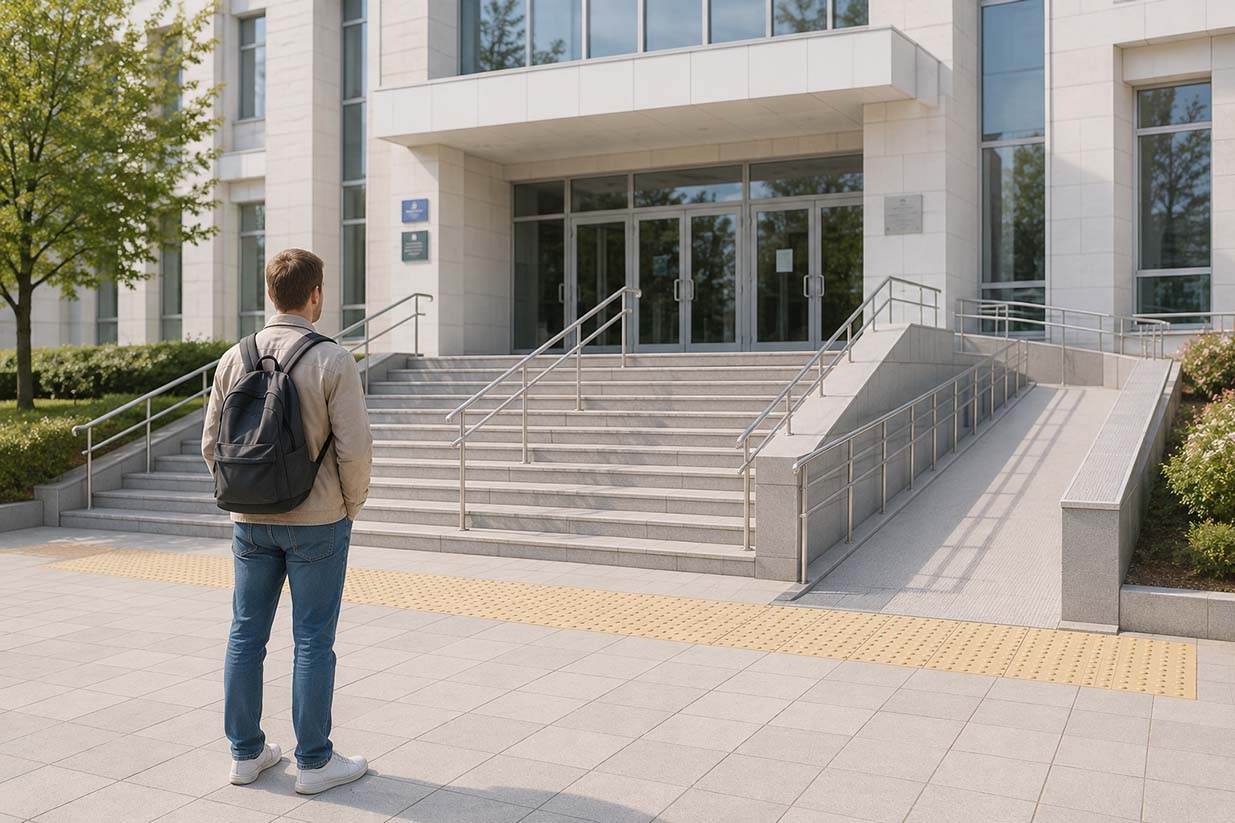
Under your feet—a yellow raised strip. It leads forward, to the crosswalk. You don’t think about it—you just walk. But someone nearby, who has poor vision or is walking with a cane, feels it under their feet and knows: it’s safe here, this is the right direction.
Everyone walks together. No one is left behind.
Glass doors. Contrasting stripes along the edges. You barely notice them. But they’re what keep you from walking into the clear glass in a hurry. And they’re what help a person with poor vision see where the door is and where the wall is.
A small detail that exists for everyone—even if most people aren’t aware of it.
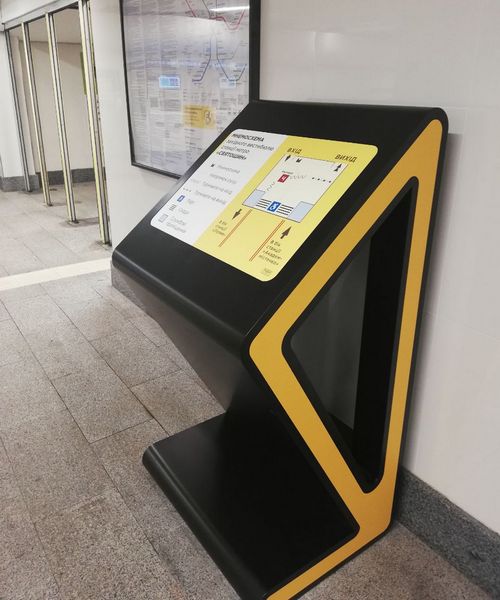
In the lobby—a large information kiosk. Reception, elevator, restroom, offices. Clear icons, large font. You take one look—and already know where to go. You don’t ask the security guard. You don’t wander the hallways. You just go.
Standing nearby is a person who has just arrived from another city and knows nothing about the place. They look at the sign too—and they know as well.
Elevator. The buttons have raised numbers, duplicated in Braille. If you can see, you just press it. If not, you run your finger along them and find the right one. The same elevator, the same button—for everyone.
On the floor is a floor plan. A raised map: here’s the hallway, here are the offices, here’s the exit. You can run your finger along it to figure out where you are and where to go. For some people, it’s just convenient. For others, it’s the only way to find their way around.

There’s a sign next to every door. The office name, the number, Braille. You read it with your eyes. Someone else reads it with their fingers. The result is the same: both found where they were going.
By the end of the morning, no one had asked anyone for help. No one stood confused in the middle of the hallway. No one felt out of place.
Just people who came to run errands—and managed to do so.
This is what a space looks like when it has thought of everyone in advance. Not just a specific group—but everyone at once. The person with a visual impairment and the person in a hurry. For those visiting for the first time, and for those who came after an injury. For a child and for an elderly person.
Tactile tiles, mnemonic diagrams, Braille signs, navigation stands, and high-contrast markings—these aren’t special accommodations. They’re a sign of a space that respects people.
This week is National Accessibility Week. A good reason to take a look around: does your space speak to everyone who comes here?